Showing posts with label gear. Show all posts

3:34 AM

How to Repair Wetsuits

If your scuba diving wet suit still has some life left in it, it is possible to repair some tears and gouges.

If a seam comes apart or you put a fingernail through the material (be careful!), you can usually fix these with no problem. You need to buy a neoprene glue or cement. You can usually find this at any good dive or surf shop or online. Commercial wet suit repair kits are also available in abundance online.

I have heard of people using the glue that is used to fix inner tubes for their wet suit repair. I have never tried this, so I can't comment on its effectiveness (or lack thereof).


The typical scenario to repair a wetsuit tear: First you fold the tear open so the two surfaces that need to adhere are exposed. You then put the wetsuit cement on the exposed surfaces and let it dry (only a couple of minutes). Then put the two surfaces together and press. You should be good to go.

Neoprene glue is flexible and will stretch with the suit. Aquaseal isn't quite as flexible and should be used where there isn't alot of strain on the repair.

Some tears can be sewn but you have to be careful about piercing the neoprene. You might also use a neoprene patch to cover the repair to make it more watertight. If you say pretty please, the dive shop might have a spare piece laying around that you can use if you don't have any available.

If you have a gouge and need to replace the neoprene, there are liquid fillers available. They are usually referred to as liquid silicon or liquid rubber. You fill up the gouge until level and let it dry. You can usually find liquid silicon for your wet suit repair in a dive or surf shop or a hardware store.

So there you have it, scuba diving wet suit repair. May all your scuba diving wetsuits last you for years to come.

*/reblogged from: http://scuba-diving-smiles.com

2:52 AM

Sea Vision 2100 Mask with Color Correcting Filter Lenses

Sea Vision is a company that is renowned for its custom ground prescription lenses that allow scuba divers to experience the same vision underwater as on land. SeaVision offers a wide range of premium scuba diving and snorkel masks, with patented color and vision corrective lenses, made from the highest quality materials that are stronger, and more efficient than glass. The Sea Vision Color Correcting filtered lenses allow divers to maximize their underwater experience whether it’s in the rich vibrant waters of the ocean or lower light situations such as lakes, rivers, or night diving.

One of the most important thing for recreational scuba diving is visibility. Being able to witness marine-life and coral in its true colors is of the highest importance, which is why color corrected scuba masks are probably one of the greatest developments in scuba equipment in a long time.


The effect of water on light is the same as a giant red filter that absorbs red light the deeper you go, leaving only blues and greens of the spectrum visible. By 3m/10′ in depth there is no red light left from the sun light underwater, and at 25m/80’ there is only the blue part of the spectrum visible.

One of the methods that can be used to overcome this color loss underwater is by using a color-correcting filter. UW filters available for cameras with different red gradients help restore the red spectrum to photographs at different depths to enhance light that is already available. In the same manner color corrected masks such as the Sea Vision 2100 uses the same filter in the lens of the mask to give the diver a better rendition of color underwater.

SeaVision is probably the most renowned manufacturer of color corrected scuba masks with patented color and vision lenses that are offered in two kinds to suit different conditions: Magenta and Yellow.

The magenta lens for use in warmer waters where colors are more rich and vibrant, designed to filter out the blue spectrum in the water, allowing your eyes to see the brilliant reds, oranges, yellows and green colors that are lost as a diver descends. The SeaVision technology adjusts the color to allow users to actually see and enjoy the colors there in front of them.

The yellow color corrective lens is for use in low light situations such as lakes, quarries, caves, rivers, and night dives. It helps to optimize available light and help improve visibility at the same time.

Seavision’s 2100 Series mask is a comfortable fitting low volume two window mask with enhanced down and side vision in a streamlined frame. The mask is equipped with swivel buckles and its skirt is made from Crystal Silicone, the highest grade of silicone available.

*/reblogged from http://aquaviews.net

1:41 PM

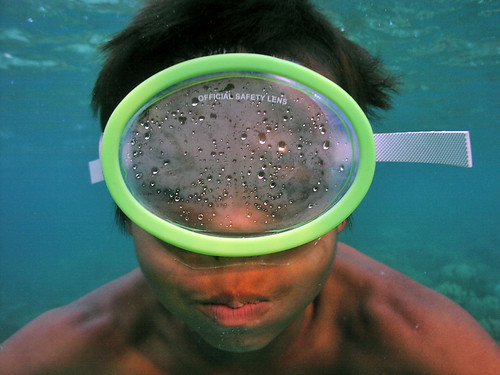
How Does Spit Work in Foggy Masks

One of the first things we are taught while learning to scuba dive is how to spit in our masks before entering the water to prevent the mask from fogging up underwater. Yes some of us have graduated to using baby shampoo or other commercially available defogging agents, but the most widely used and most easily available solution to a foggy mask is the good ‘ol fashioned spit and rub of the insides of your dive mask. Ever wonder what makes ordinary saliva so effective against fogging of masks?


Before we get to how spit works in this scenario, let’s take a closer look at why a scuba mask fogs up in the first place. A Scuba mask fogs up when the inside of the lens is at a temperature below the dew point of the air inside the mask. This drop in temperature causes water to condense on the inside of the glass lens forming tiny droplets causing the fogging. The surface of the glass in your mask is potholed or riddled with microscopic depressions almost like a golf ball or the surface of the moon when magnified under a microscope. Moisture is attracted to this uneven surface and adheres to the front causing the fogging similar to what we experience on our car windshields on a cold day. Decreasing the surface tension of these water droplets and creating a moisture film prevents fogging.

So how does Spit help in defogging a mask? Saliva acts as a surfactant. Surfactants are wetting agents that lower the surface tension of a liquid, allowing easier spreading. Surfactants prevent water droplet formation and cause the water to break up and spread easily. The term surfactant is a blend of the words surface acting agent. As a surfactant; saliva decreases the surface tension of the droplets. The water from the condensation does not mound up as beads or droplets but, instead breaks to form bigger droplets that just roll away into the mask. So the water condensation on the insides of the mask don’t adhere to the glass but instead break up and roll down into the mask itself, giving the scuba diver clear vision.

Ok so why use Spit when there are so many types of surfactants available? Well simply because it’s the most conveniently available surfactant and it works really well too. Spit being a natural bodily fluid also doesn’t irritate the divers eyes unlike a detergent or soapy liquid which could sting. You could just as easily use shampoo, detergents, toothpastes, soaps, alcohols, or glycerin all used by divers as a spit alternative used to the same effect. You could also purchase manufactured defogging solutions. But spit is free, plentiful and doesn’t require a wetsuit with pockets to carry around!

*reblogged from http://www.aquaviews.net

4:59 AM

Underwater Scooters

Underwater scooters also known as diver propulsion vehicle, is an item used in scuba diving mostly which helps divers to use less air. The amount of air consumed mostly depends on the calories you burn underwater. So, this simply means you go faster, you breathe more. Logical isn't it? But this is the last thing a scuba diver would want since they have restricted amount of air in their tank. So, it seems better to consume minimum air in order to be underwater as much as possible.


To achieve the maximum time underwater depends on how relax you are while diving. Of course you can do it by getting some experience. However, in any cases you should use your legs to give your fins the propulsion force, doesn't matter how much experience you have here. Instead of using your legs, it is an alternative to use underwater scooter. It gives you the feeling of smooth diving.

Don't hesitate to try it. I know it seems a bit muscular but it is very silent indeed and it does not do much speed underwater, it imitates your fins speed.

4:55 PM

Tips about Masks

Your window to the underwater world, scuba masks are an important piece of scuba giving gear. They are also one of the first pieces of gear you’ll want to own rather than rent, even as early as your first scuba certification. Most divers put a great of effort into finding and selecting the right kind of mask with the perfect fit for themselves. It’s no wonder then that a Dive Mask is also a piece of equipment that divers are fondly attached to. So if you’re as fond of your scuba diving mask as I, here’s a look at some tips I’ve found useful along the way regarding problems with your mask or just tips on taking better care of it.


When buying a scuba mask, it’s very important to look at the silicon skirting around the mask. The skirting and shape of the mask must fit your face well to provide you with a comfortable fit. The quality of the silicon should be good. Higher quality silicon is usually found in the more expensive models and will feel softer and more flexible than poorer grade silicon.

Another important consideration to make while picking out a dive mask is the nose pocket. Different types of masks have different shaped nose pockets. Check that your nose fits comfortably in the pocket without touching your nose. This will help protect and cushion your nose as well as have necessary air pockets that’ll help equalizing and purging water out in case any gets in.

Brand new masks usually have a coating of silicone left over from the manufacturing process on the lens that will cause it to fog constantly, no matter how many defogging agents you try. So, first you’ll have to treat it to remove any traces of this coating before using it on a dive. You can rub the inside and outer glass surfaces with a tiny pearl of toothpaste using your index finger and leave it overnight, before wiping it off with a soft cloth or washing it. Another way to go is to burn the residual coating on the lens by running the tip of a flame over the lens.

If you frequently face a foggy mask, pay closer attention to your breathing. More often than not you’ll notice you tend to try breathing out your nose unconsciously before you expel air out your mouth. When you breathe out through your nose, even slightly, the warm air from your body creates condensation, or fog, on the inside of your mask. Breathing out your mouth only will help your mask will stay crystal clear. Adjust your breathing technique and pay closer attention to consciously avoid breathing out your nose, unless you’re clearing your mask. This will prevent your mask from fogging up despite using a de-fogging agent.

One of the most important things to ensure your mask stays with you a long time is to keep it out of contact with direct sunlight as much as possible. Harsh Sunlight and high temperatures attack the rubber and silicone of masks, turning the translucent soft silicone into a yellowing harder mass, that causes mask leaks and degradation over time. Mask bands and straps exposed to sunlight, form cracks and may break easily when stretched. Always store your mask inside its case in a cool dark place but not moist. If you have a silica gel packet or desiccant, place this inside your mask case to keep the moisture at bay.

*reblogged from http://aquaviews.net

4:35 PM

How to Assemble Scuba Equipment

It's the challenging thing to do at the begining. I found I good video demonstrating how to assemble a scuba equipment.